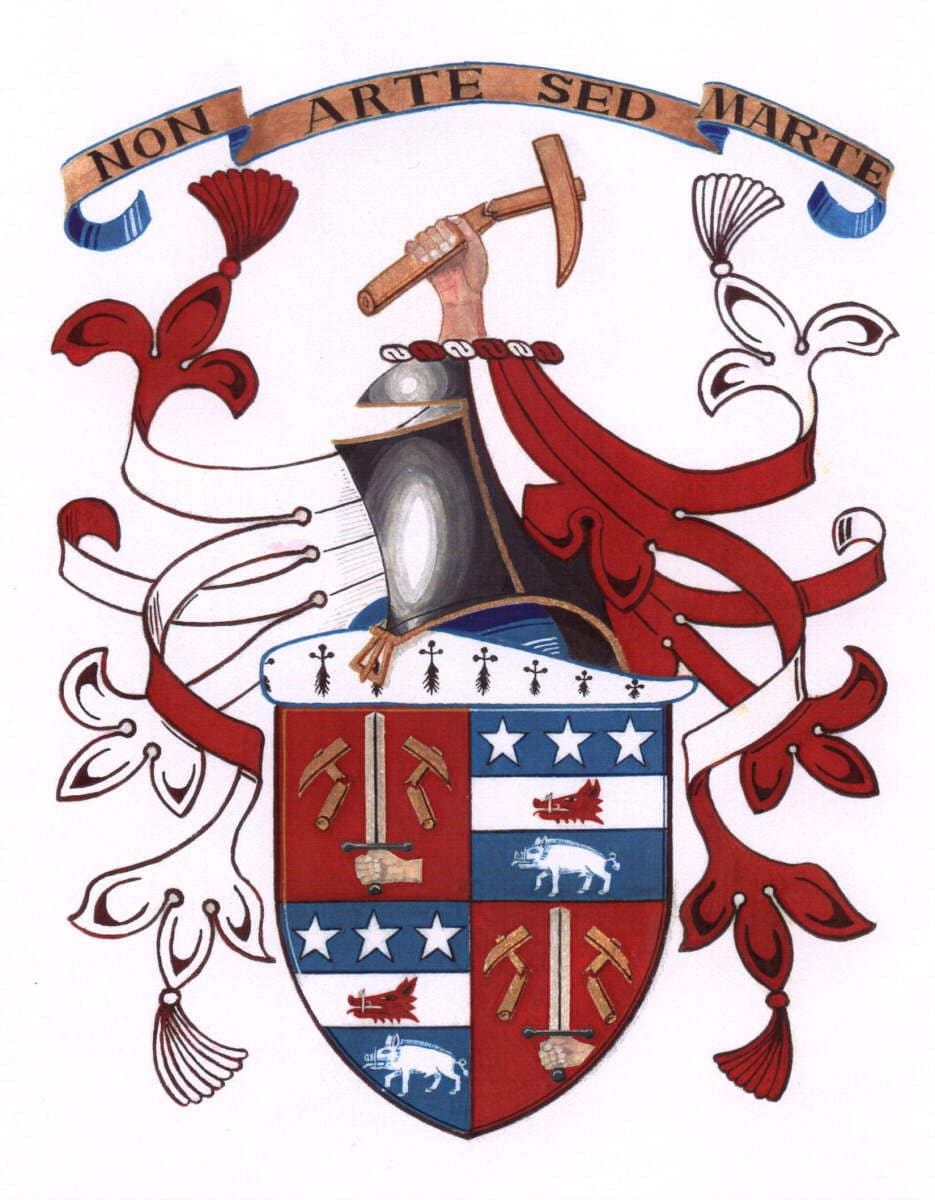
Herald: Dónal Burke : Herald Painter: Philip Mackey.
Meaning & Symbolism of the Arms:
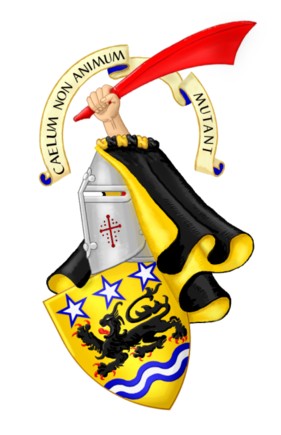
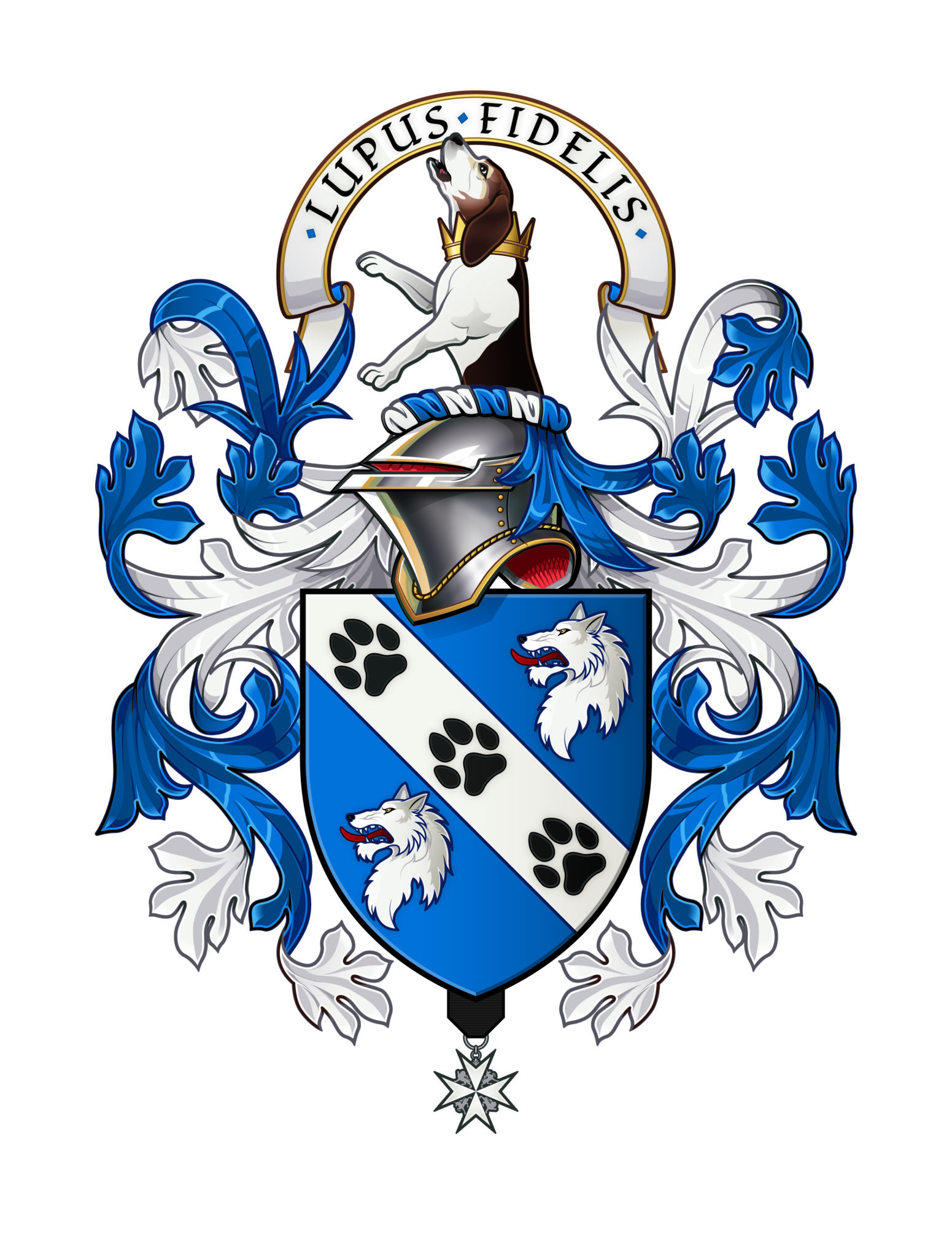
General: Azure (blue) ancient colour representing Ireland. The imagery evokes the sounds and sights of the island of Ireland as encountered by our early ancestors on their arrival, the seagulls as they approached land and the sounds of the wolves and the herds of wild boar.
The wolf (Irish: ‘Mac tire’ literally ‘son of the land’) was the top predator, preying on the boar (Irish: Torc), deer and, even livestock in an Ireland that was referred to as “Wolf Land” in the seventeenth century. However, both wonderful creatures were hunted out of existence, noting the fragility of nature and our natural heritage. Given the importance of the totemic or emblematic symbolism, mythology and folklore associated with the wolf and the boar for the armiger’s Gaelic ancestors, the disappearance of these native species at the hands of later invaders unfortunately coincided with the destruction of the ancient Gaelic civilisation in Ireland.
The wolf also alludes to the ancient genealogies of the tribes of Leinster like the clans/septs descending from the Uí Fhaoláin (‘faol’ = ‘wolf’) such as the O’Byrnes of Wicklow and associated families, including the Merrigans – Uí Mhuireagáin.
It could also be interpreted as a pun on the sounding of the surname ‘Merrigan’ and its similarity to the ‘Morrigan’ (Irish Goddess of War) and the reference in ‘Táin Bó Chuailgne’ to the ‘Morrigan’ changing into a “grey she-wolf” (Wolf Argent above) although, here the wolf is male.
The military pike represents the Irish people’s struggle for freedom, defence of their heritage and language and, in particular, it evokes the Great Rebellion of 1798.
The European Herring Gull (Larus Argentatus) represents the sea bordering the homeland of the armiger’s ancestors – the province of Leinster, specifically counties Wicklow and Dublin. The seagull is associated with the Celtic sea god, Manannán Mac Lír, and its inclusion here represents the armiger’s genetic ancestry in the Irish Sea Haplogroup, R1b-Z16434. Also, the sound of the seagulls in the armiger’s hometown of Dún Laoghaire greets its residents every morning and is ever present during the day.
The imagery evokes the natural and cultural heritage of the armiger’s ancestors in Ireland and the Motto alludes to his interest in genealogical research (co-founder of the Genealogical Society of Ireland) and genetic genealogy (co-founder of the Irish DNA Atlas).
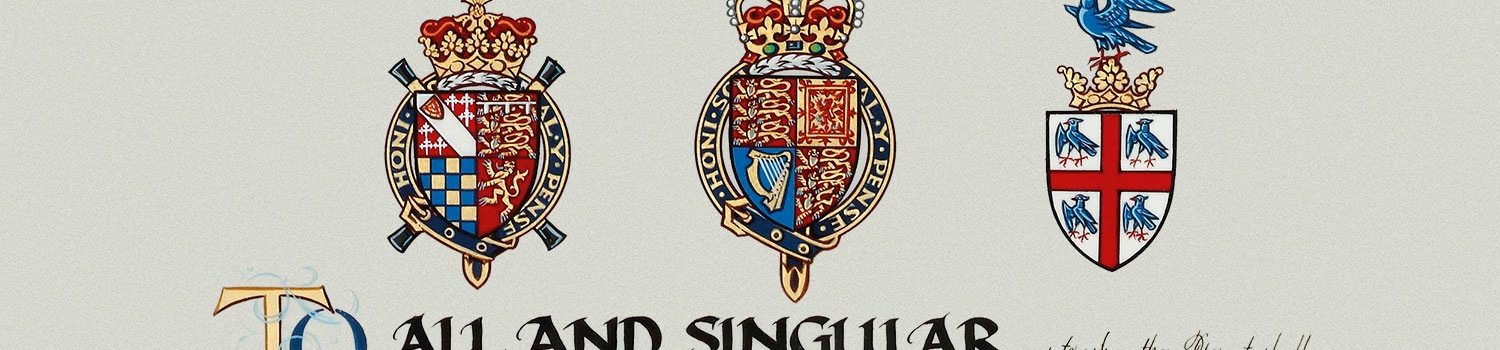
The text of the ‘Letters Patent’ is in both the Irish and English languages and records the armiger’s genealogy to his great great-grandparents and that, the grant extends to the other descendants of his father, observing the appropriate heraldic differencing as determined by the ‘Laws of Arms’ in Ireland. The document also mentions the armiger’s long-time partner, the late Andrew Gerard Ball, originally of Brisbane, Queensland, Australia, who died May 16th 2021.
The armiger is the General Secretary of the Genealogical Society of Ireland (including its Specialist Branches – Heraldry Ireland and Vexillology Ireland) and a member of the Heraldry Society (UK), the Association for the Study of Ethnicity and Nationalism (LSE, UK), the Guild of One-Name Studies (UK), and the Society for the Study of Nineteenth Century Ireland.